
WSPRDraft FlueSilencers
Tested at Fraunhofer IBP to ISO 7235
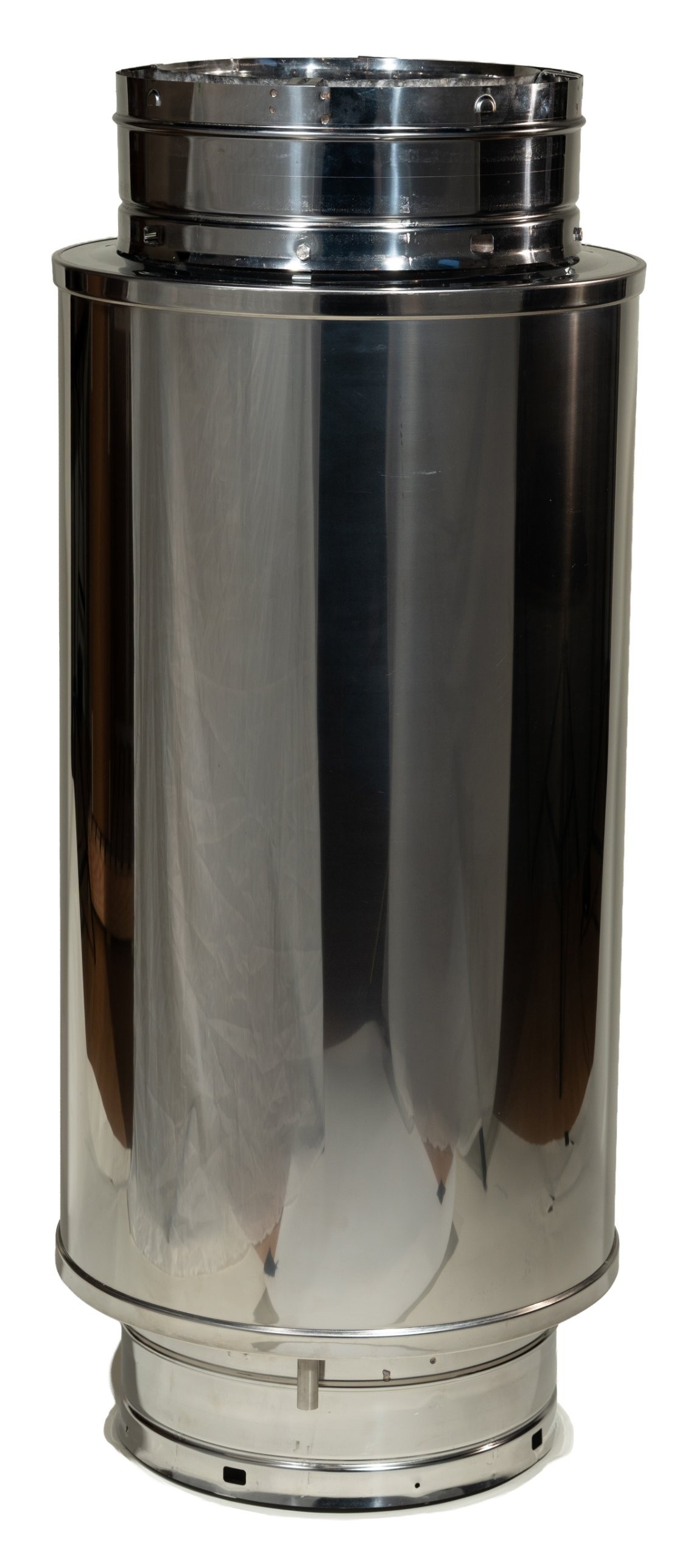
Motor noise travels down a flue like a voice down a pipe, and WSPRDraft absorbs it on the way. Independently tested, band by band, with the data published.
- Fuel
- Gas appliances only
- Tested at
- Fraunhofer IBP, ISO 7235
- Body and mesh
- 316L stainless
- Absorber
- Mineral wool
- Drain
- Built in, for condensing applications
How it works
Stop Sound Before It Reaches the Room.
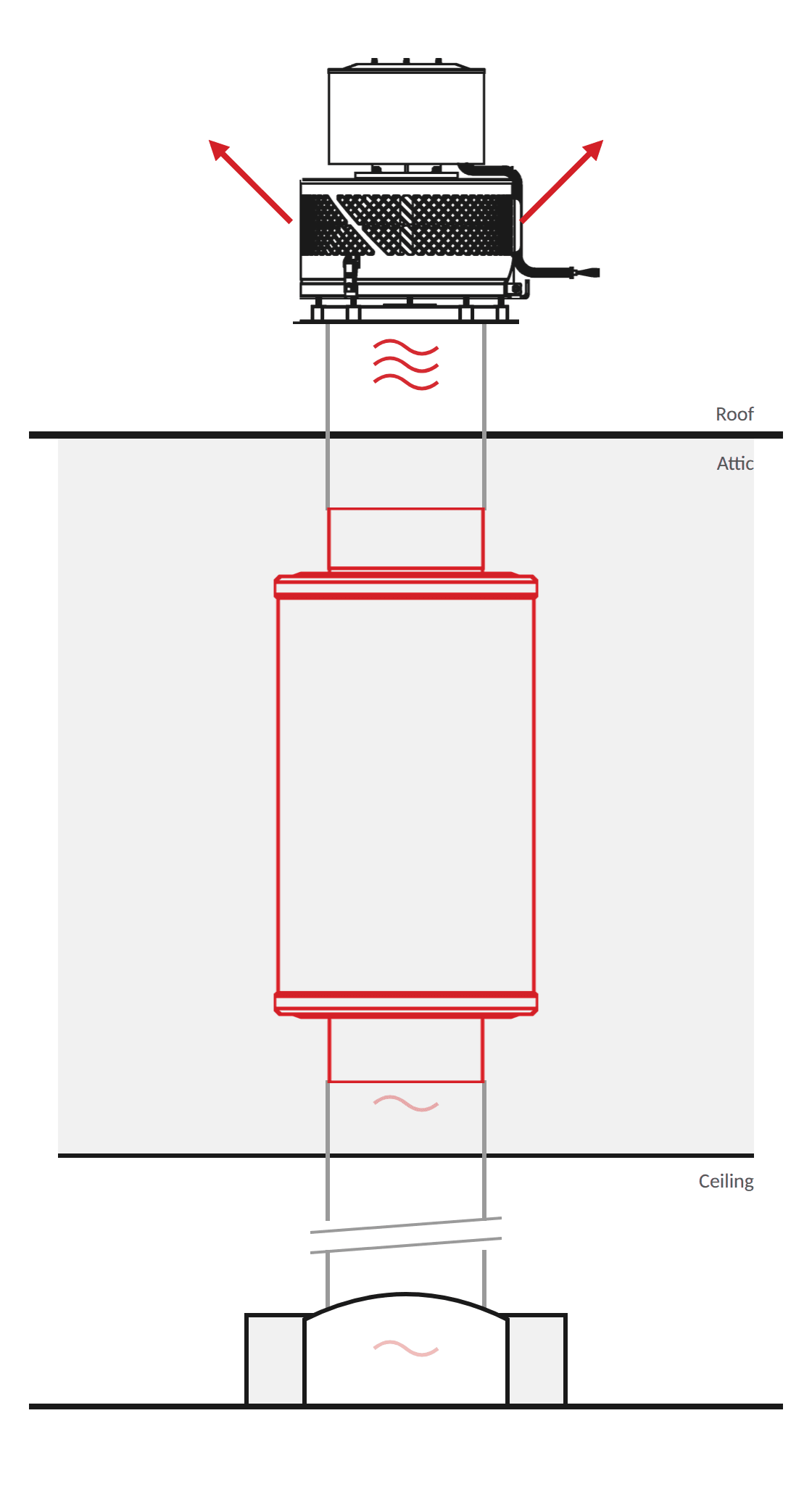
Mechanical noise starts at the motor and travels down the chimney into the building. WSPRDraft sits in the flue between the draft inducer and the room and absorbs that noise on the way down.
It works with the rest of the system: a draft inducer that runs only as hard as needed, a 45° upward discharge, and a vibration dampener that keeps vibration at the draft inducer.
The controller lowers the sound the draft inducer makes. WSPRDraft absorbs what is left before it reaches the room. For bedrooms, media rooms, and open living spaces where the fireplace is part of the room, specify both.
Gas fires are quiet. That's why draft inducer noise shows up there first. A wood fire masks a draft inducer with its own crackle and rush. A gas flame doesn't, especially on an open-face fireplace with nothing between the room and the flue. WSPRDraft is built for exactly that, and it is for gas appliances only. On solid fuel, quiet comes from the controller and the vibration dampener.
WSPRDraft is part of a matched X-VENTISO system: XV Series draft inducer, controller, vibration dampener, and silencer, designed and supported together. Published performance applies to that system.
Construction
Straight Through. Absorbed, Not Blocked.
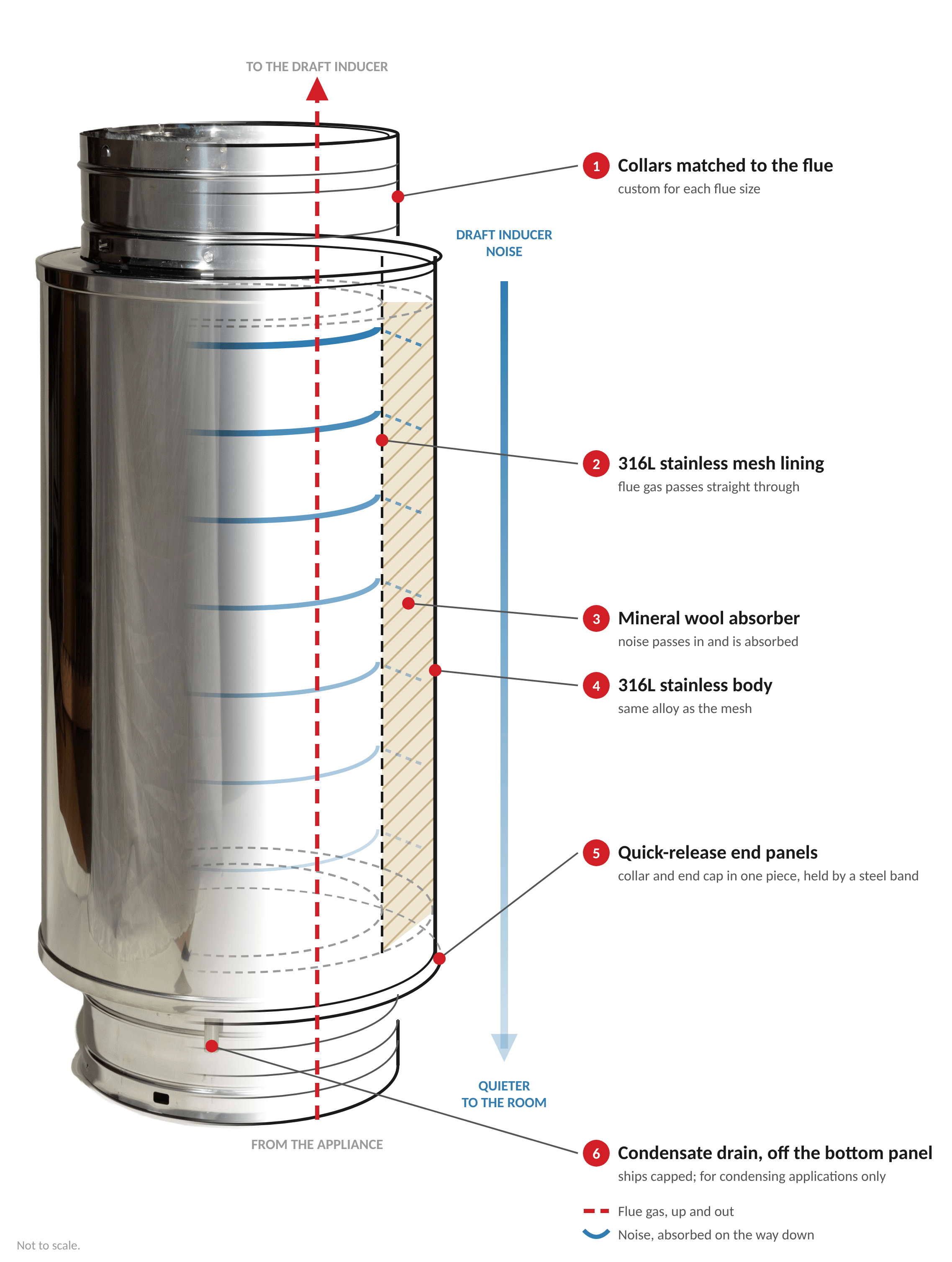
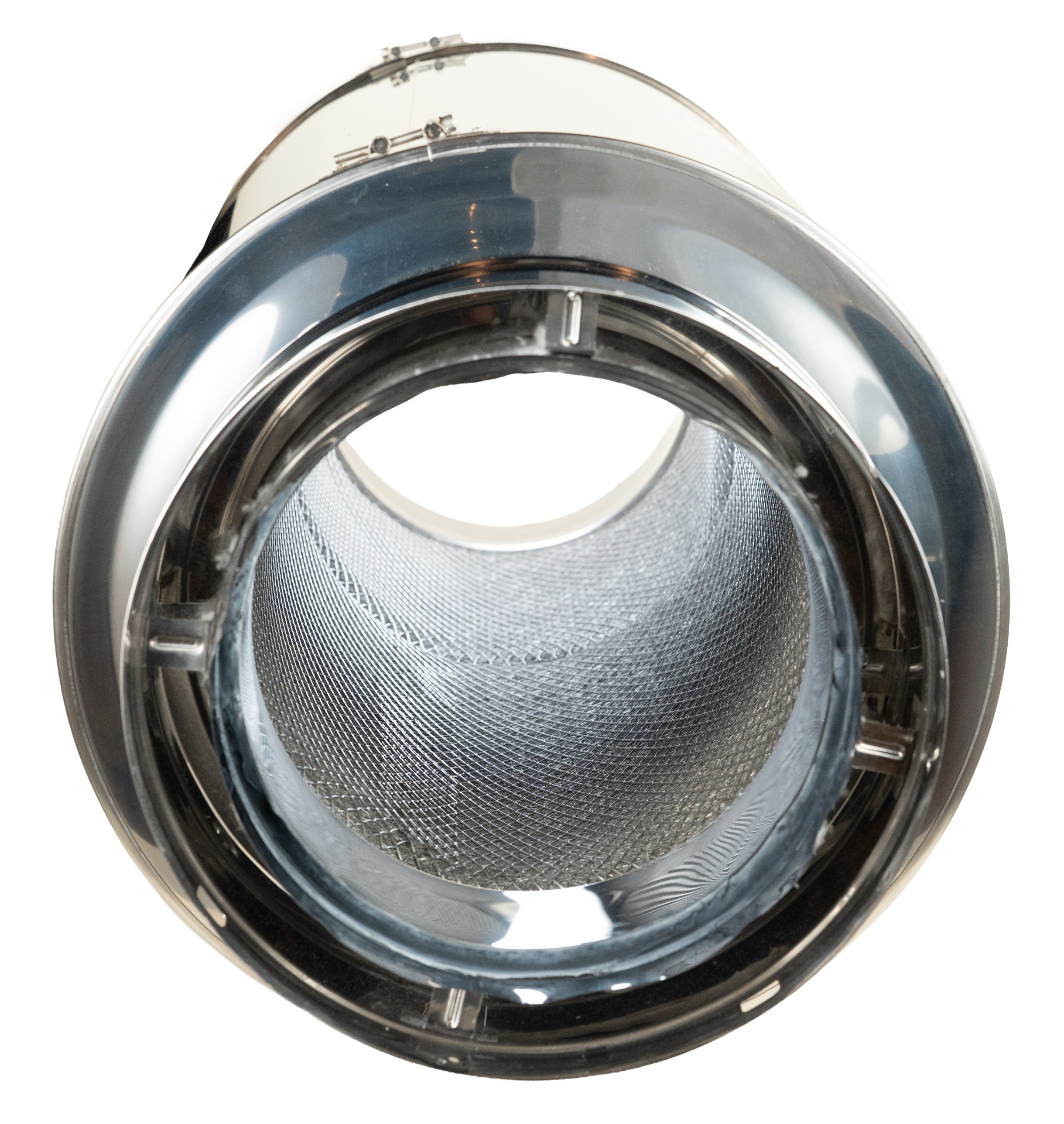
WSPRDraft is a straight-through absorptive silencer. Flue gas runs straight through a 316L stainless mesh lining with nothing in its path. Sound does not stay in the gas stream: it passes through the mesh into the mineral wool behind it, where it is absorbed.
Nothing in the gas path. No baffles, no turns. With a resistance coefficient of 0.25, WSPRDraft adds very little for the draft inducer to overcome, so a quieter flue does not cost draft.
Absorptive, where it counts. An absorptive silencer does its best work in the mid frequencies, and that is where XV Series draft inducers make most of their sound. It is also why WSPRDraft is for gas only: mineral wool is not made for creosote and soot.
Long core, one alloy. The 10" to 14" body carries ~35" of absorber in a 44" unit. Body and mesh lining are 316L stainless, rated for flue gas up to 752°F (400°C) and tight to 200 Pa positive pressure.
Quick-Release End Panels
At each end, the collar and end cap are one piece, held on by a steel band. Release the band to open the end for cleaning.
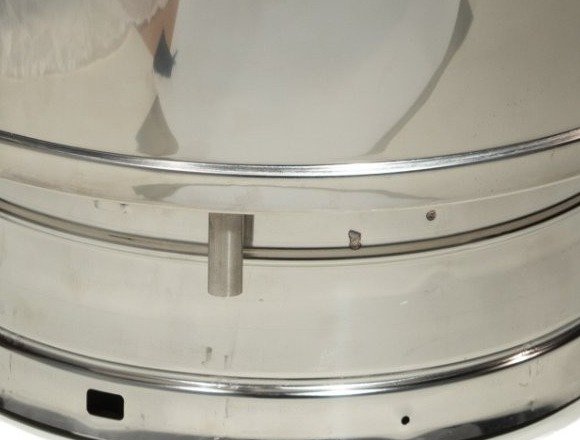
Condensate Drain, Built In
Off the bottom end panel, standard on every unit, ready for condensing applications. Ships capped from the factory; uncap and connect it only where the appliance produces condensate.
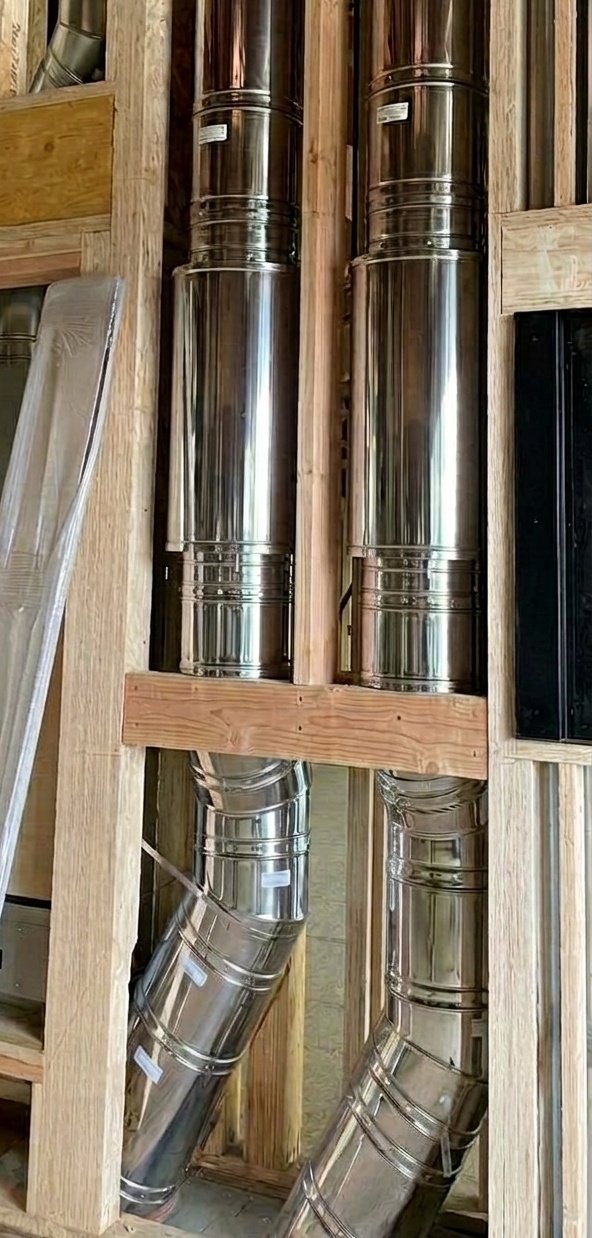
Installing It
Support the silencer on its own, not from the flue, and keep it free of vibration. The silencer body weighs ~51 lb (8"), ~53 lb (10" to 14"), or ~57 lb (16"). Shown: two WSPRDraft silencers in a framed chase, on Earthcore Eco-Steel flue.
Performance
Insertion Loss by Frequency.
Silencer performance varies by frequency, so we publish it band by band. WSPRDraft does its best work from 500 to 2,000 Hz, the range where the ear is most sensitive.
| Insertion loss (dB) / octave band (Hz) | 63 | 125 | 250 | 500 | 1k | 2k | 4k | 8k |
|---|---|---|---|---|---|---|---|---|
| XV-WDR-8 | 4.6 | 9.3 | 14.6 | 19.2 | 26.6 | 26.8 | 13.5 | 12.2 |
| XV-WDR-10, 12, 13, 14 | 3.2 | 5.9 | 12.3 | 21.6 | 27.5 | 17.5 | 13.2 | 13.2 |
| XV-WDR-16 | 2.4 | 3.6 | 11.9 | 24.7 | 23.3 | 12.7 | 12.0 | 14.8 |
Shaded: 500 to 2,000 Hz, the range where the ear is most sensitive. XV-WDR-10, 12, 13, and 14 are built on the same silencer body, so their insertion loss is the same; only the collars differ.
Paired with an XV Series draft inducer at full speed: ~16 to 20 dB less sound traveling down the flue, depending on size.
Insertion loss in dB by octave band for the silencer body, measured at the Fraunhofer Institute for Building Physics (IBP) to ISO 7235. Flue reduction is calculated by applying that insertion loss to sound power data measured at Riverbank Acoustical Laboratories (ANSI S12.51 / ISO 3741) for the XV150, XV250, and XV350 at full speed.
Matched to the draft inducer
Matched to the XV Series. Not to Just Any Draft Inducer.
XV Series draft inducers put nearly 90% of their sound energy in the 500 to 2,000 Hz bands, and that is exactly where WSPRDraft works hardest, peaking at 1,000 Hz. The silencer's best work lands on the draft inducer's loudest sound.
That match is why the reduction down the flue is so large, and it is measured on both sides: the draft inducers at Riverbank Acoustical Laboratories, the silencer at the Fraunhofer Institute for Building Physics.
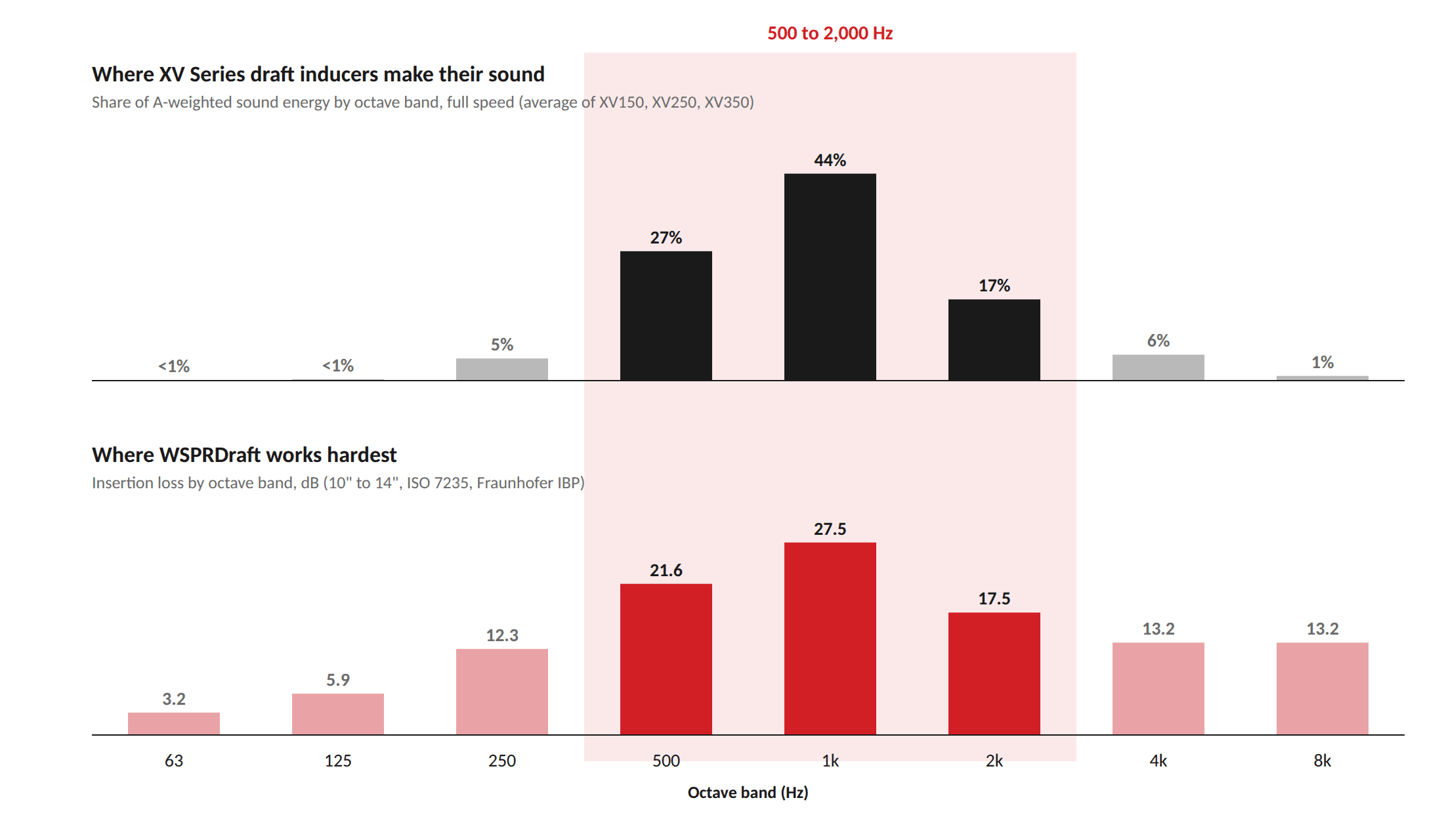
Another manufacturer's draft inducer makes its sound in its own places. WSPRDraft performance is published and supported only with XV Series draft inducers.
Tested, not described
Any Silencer Can Claim Quiet. Ask for the Report.
A silencer is easy to describe: a stainless shell, an absorber, a path for the flue gas. Words like "quiet" and "acoustic insulation" cost nothing to write. What separates one silencer from another is a measurement, made by someone with no stake in the result.
WSPRDraft insertion loss was measured at the Fraunhofer Institute for Building Physics to ISO 7235. The draft inducers it pairs with were measured at Riverbank Acoustical Laboratories to ANSI S12.51 / ISO 3741. Both are published, with the data behind them.
We didn't test in our own shop. We took it to labs the building industry already trusts.
Geneva, Illinois
Riverbank Acoustical Laboratories
Built in 1918 for Wallace Clement Sabine, a founder of architectural acoustics. More than a century of measuring sound, accredited by NIST under NVLAP. Tested the XV Series.
Stuttgart, Germany
Fraunhofer Institute for Building Physics
Part of Germany's Fraunhofer-Gesellschaft research organization, with acoustics among its core fields. Tested WSPRDraft.
01
Which Lab?
An independent laboratory, or the company selling it?
02
Which Standard?
ISO 7235 measures silencer insertion loss. Without a standard, a number is a description.
03
Where Is the Data?
Band by band, from the report, or one round number with nothing behind it?
Download the Acoustic Data Sheet (PDF, opens in a new tab)Insertion loss by octave band, test basis and report number.
Specifications
WSPRDraft Specifications.
| Specification | Value |
|---|---|
| Sizes | 8", 10", 12", 13", 14", and 16" (XV-WDR-8 to XV-WDR-16) |
| Overall dimensions | 10", 12", and 14": 44" tall, 20-3/16" diameter. 13": 45-3/4" tall, 20-3/16" diameter (same body; larger collar for Eco-Steel). 8": ~44" tall, 17-3/4" body diameter. 16": ~48" tall, 23-5/8" body diameter. |
| Fit | Custom collars matched to the flue size. The 13" model fits Earthcore Eco-Steel 13" all-fuel pipe (larger outer diameter). |
| Configuration | Straight lengths (US) |
| Materials | 316L stainless body and mesh, mineral wool absorber |
| Drain | Condensate drain built into every unit, for condensing applications. Ships capped; connection not required where the appliance does not produce condensate. |
| Fuel | Gas appliances only |
| Flue gas temperature | Up to 400°C (752°F) |
| Positive pressure | Up to 200 Pa (0.8 in. w.c.) |
| Resistance coefficient (ζ) | 0.25 |
| Test standard | ISO 7235:2003, Fraunhofer Institute for Building Physics (IBP), report IP-TA 6_2004, 2004 |
Downloads