
XV Series
Draft inducers for gas, solid fuel, and grease
More pull, not just more air. XV Series draft inducers give the chimney a steady, controlled exhale, and three sizes cover gas, solid fuel, and grease. No circuit to run to the roof: each one plugs into its controller below.
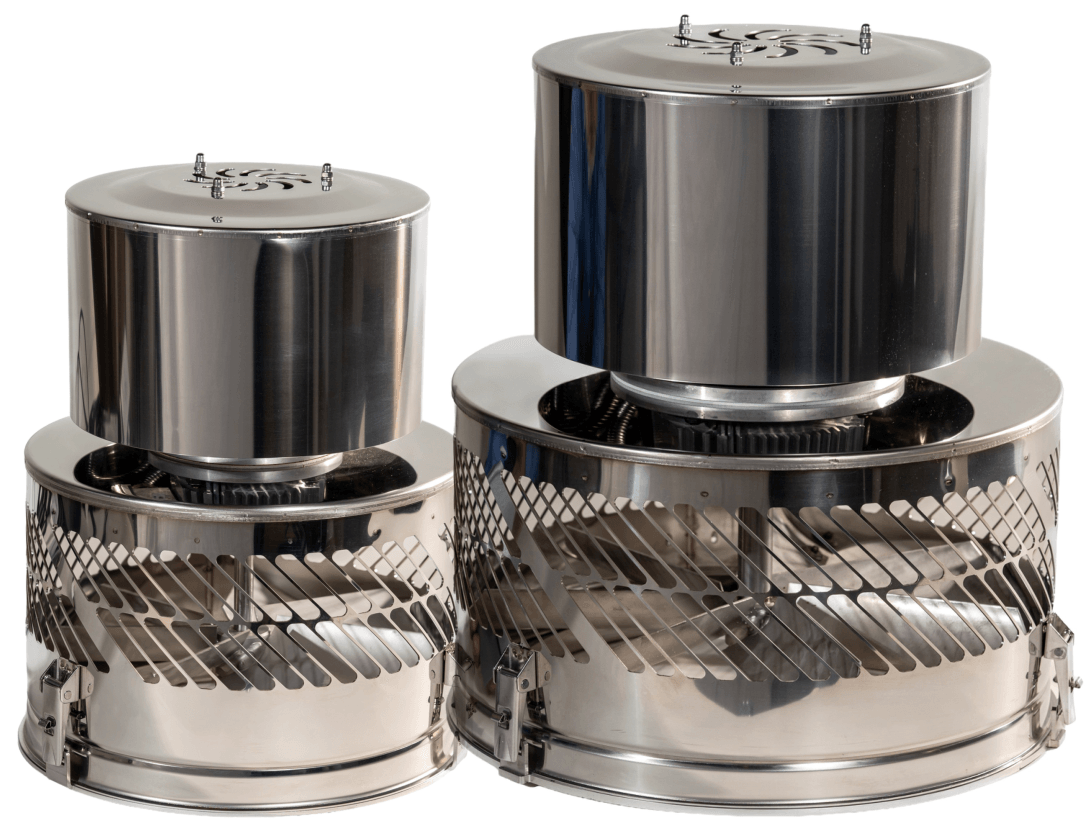
- Sizes
- XV150 · XV250 · XV350
- Listed for
- Gas, solid fuel, and grease
- Temperature
- 1,000°F continuous · 1,400°F intermittent
- Material
- 316L stainless housing and impeller
- Roof wiring
- None. Plug-in Molex to the controller
Performance
Built for resistance.
Moving air through open space is easy. Chimneys create real-world resistance: every elbow and return, every horizontal run, even the wind. XV Series draft inducers are built for pressure, so they keep moving air when the chimney fights back.
Size every job with the free flue calculator (opens in a new tab), or send the plans and we will size it with you.
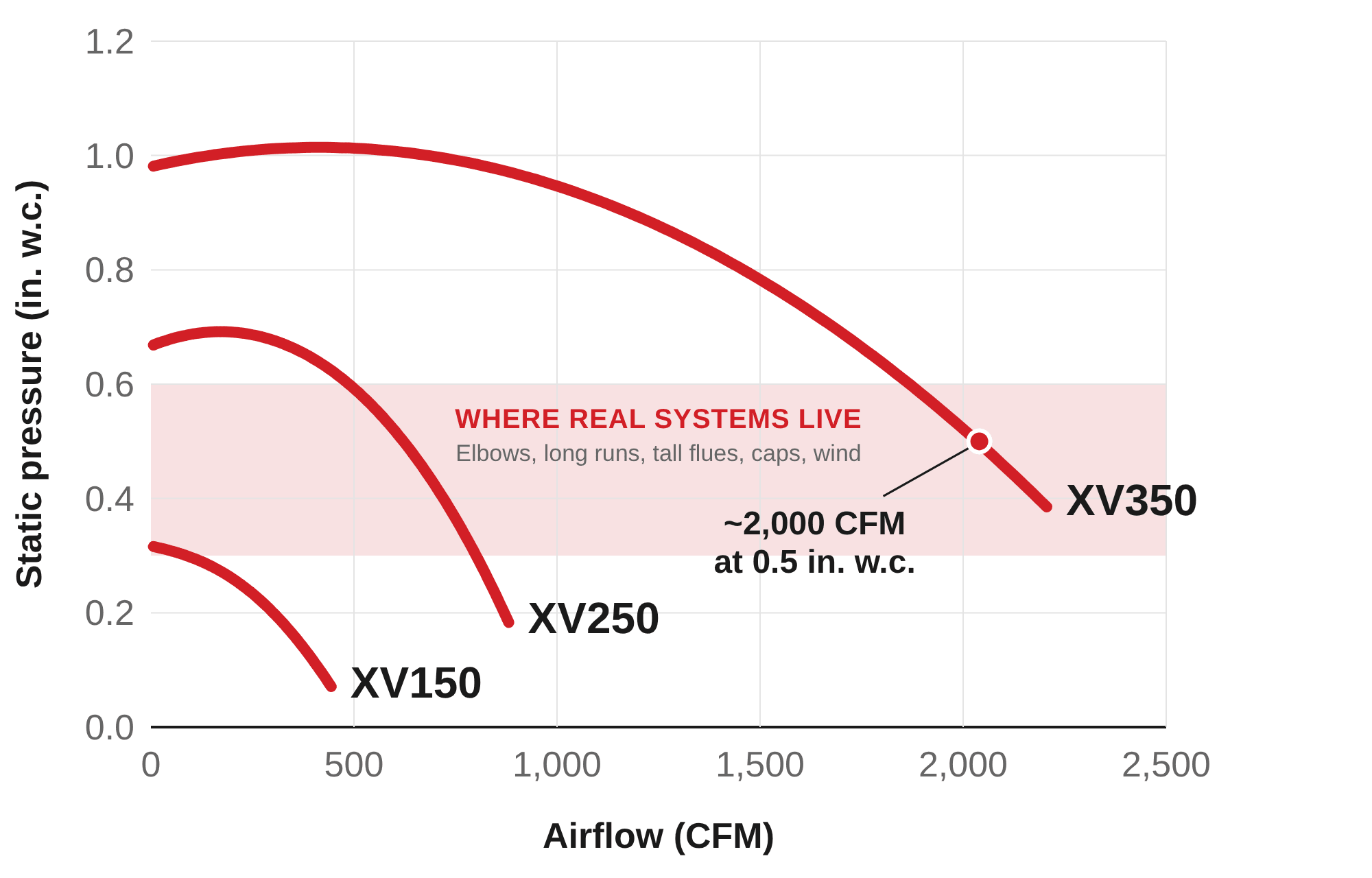
Don't size on free-air CFM. Check the curve at your system's pressure. The shaded band, 0.3 to 0.6 in. w.c., is where most of the chimney systems we calculate land.
Full speed, 120 V.
Tested sound
Quiet, measured. Not just promised.
Every XV Series model was tested by Riverbank Acoustical Laboratories in a reverberation room to ANSI S12.51 / ISO 3741 (report Lw25-004, March 2025), at full speed and at reduced controller settings.
Sound power is the noise the draft inducer itself produces, the source number engineers use to work out what reaches a room. It falls sharply as speed comes down. To the ear, every 10 dB drop sounds about half as loud.
That is why X-VENTISO controllers matter for sound: a draft inducer set to what the chimney needs, or modulated by Meridian, spends its hours below full speed.
At 38 V, a typical commissioning setting, an XV350 tested 34 dB below full speed. To the ear, roughly a tenth as loud.
| Sound power, LwA (dBA) | XV150 | XV250 | XV350 |
|---|---|---|---|
| Full speed (120 V) | 67 | 74 | 83 |
| 38 V, our typical commissioning setting | 42 | 51 | 49 |
| Drop from full speed | 25 dB | 23 dB | 34 dB |
A-weighted sound power level, LwA, in dBA re 1 pW. Draft inducer only, no silencer, measured in a reverberation room. Commissioning speed is set for each chimney, and some need more than 38 V. What is heard in a space also depends on the flue, the silencer, the building, and distance.
Download the XV Series Sound Data Sheet (PDF, opens in a new tab)Results at intermediate speeds and full octave-band data are available to specifying engineers. Request the test data
One line, every fuel type
Listed for gas, solid fuel, and grease.
The same draft inducer is listed for gas, solid fuel, and grease, from fireplaces to wood-fired ovens and commercial kitchen exhaust. It is rated to 1,000°F continuous and 1,400°F intermittent. Size it properly, and you are done.

Intertek control no. 4007025
| Listing | Scope |
|---|---|
| UL 378 | Draft equipment |
| UL 705 | Power ventilators |
| UL 705 Supplement SC | Restaurant exhaust (grease) |
| CSA B255 | Draft equipment, Canada |
| CSA C22.2 | Fans and ventilators, Canada |
| ULC-S645 | Restaurant exhaust (grease), Canada |
Construction
Built to last. Quiet by design.
Material
316L stainless
Housing and impeller resist acidic condensate.
Motor
Out of the gas stream
The motor is kept out of the flue gas path.
Service
Tool-less access
Clamp and hinge open the draft inducer for cleaning and maintenance.
Safety
Spark arrestor
Cut directly into the draft inducer body.
Sound
45° discharge
Curved axial vane blades send exhaust and sound up and away from the building.
Installation
Factory-wired
Service disconnect at the draft inducer, Molex to the controller. No field wiring.
Installation
No circuit to run to the roof.
Many draft inducers need an electrician to run a 120V circuit up to a junction box on the roof. XV Series draft inducers don't. Each one ships factory-wired, with a service disconnect at the draft inducer and a cable ending in a 3-pin Molex that runs down the chase to the controller. The controller plugs into a standard 120V outlet. No roof circuit, no junction box, no field wiring at the roof.
Do the math
Price what stays off the job.
A draft inducer that needs line power at the roof puts an electrician on the job for:
- A dedicated 120V circuit run up to the roof
- Weather-rated wiring or conduit through the chase
- A weatherproof junction box and disconnect at the draft inducer
- GFCI protection, where code calls for it
- The trip up, and the return trip for the inspection
XV Series: none of it.
The service disconnect is built into the draft inducer. The installer plugs in a Molex cable, and the controller plugs into a standard 120V outlet below.
Ask your electrician what that list costs on your job.
Several on one chase.
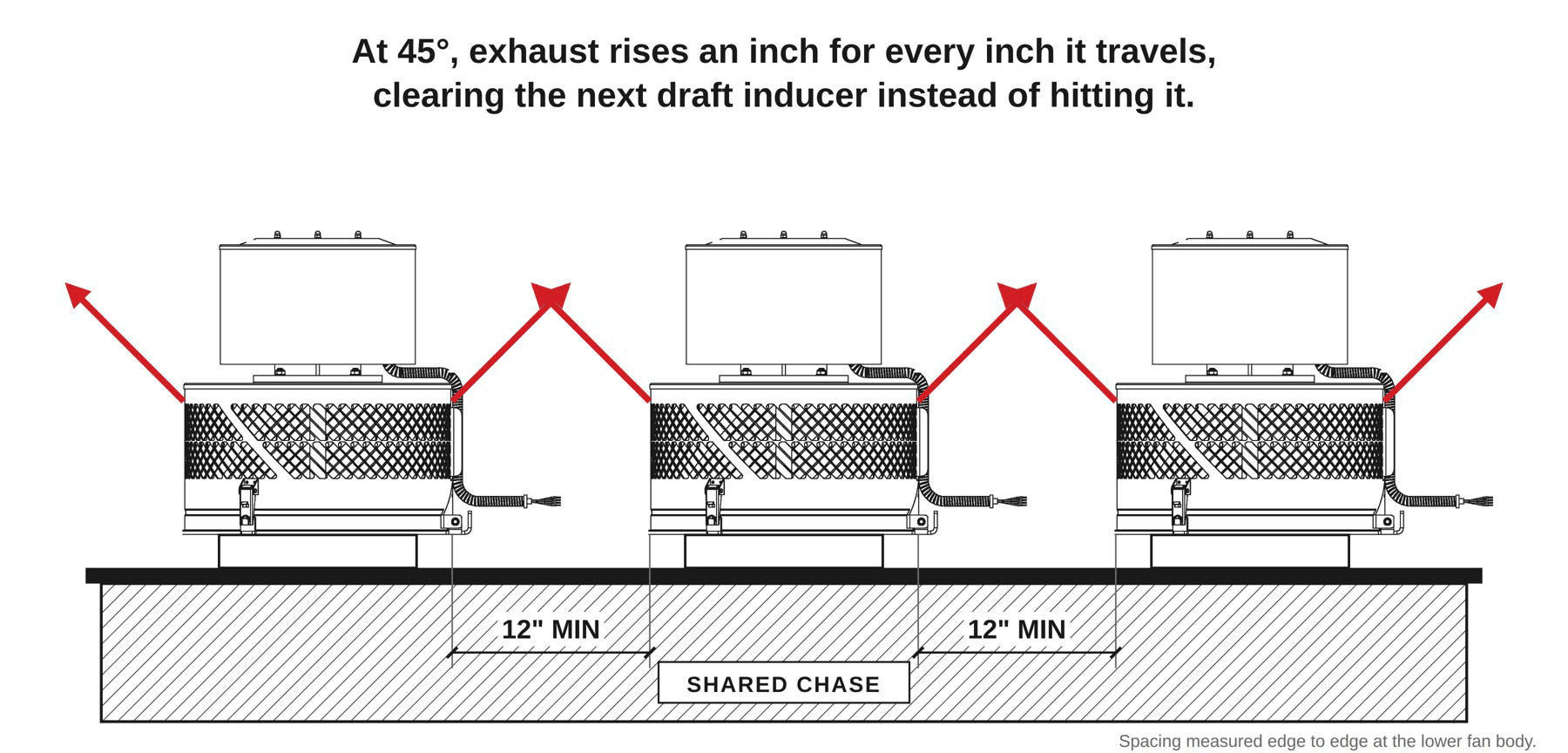
12"Edge to edge, minimum
That is the minimum spacing between XV Series draft inducers on a shared chase. At 45°, each one sends its exhaust up and over the next one instead of into it.
Closer spacing means a smaller chase top: less framing, less cladding, a smaller shroud. Check the spacing in any other draft inducer's installation manual and lay out both.
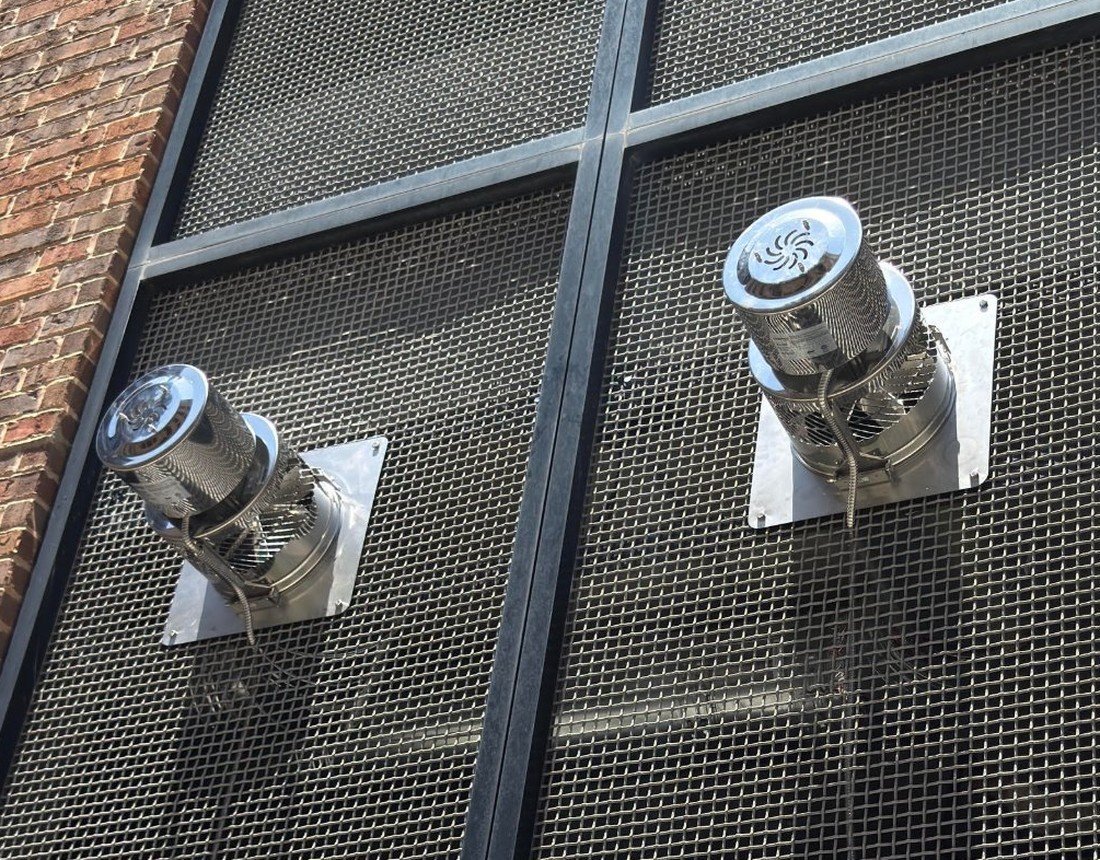
Vertical or horizontal, at the end of the run.
XV Series draft inducers mount wherever the flue run ends: on top of a chimney, or on a wall for a horizontal termination.
Each one is its own system, on its own flue, with the same factory-wired, plug-in install either way.
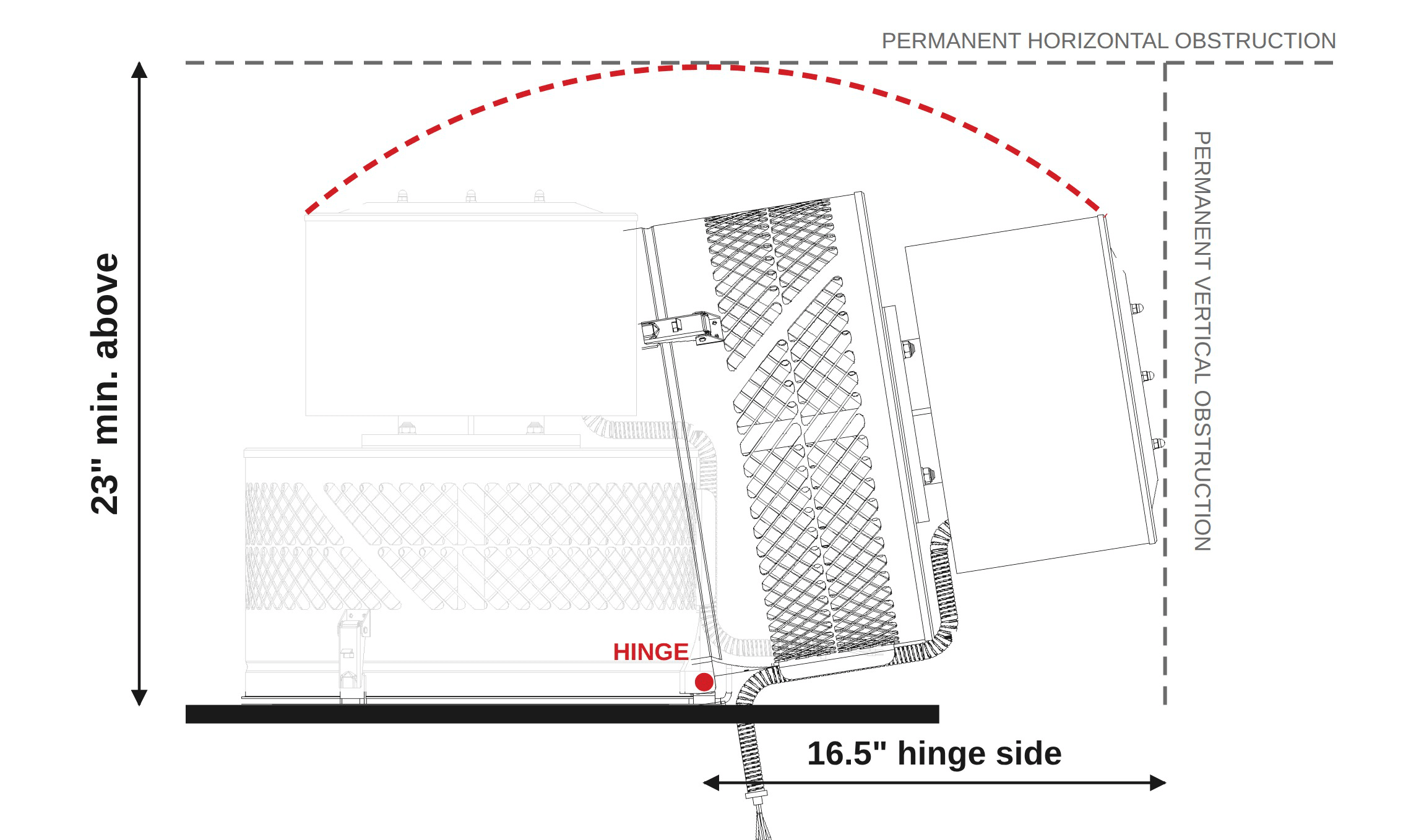
Service clearance
Leave room to open it.
Every XV Series draft inducer opens on an integrated hinge for cleaning and service. Keep permanent structures, like a roof overhang, a wall, or a chimney shroud, clear of the full opening arc.
The draft inducer body rests open on its own at the hinge stop.
| Model | Clear height above | Hinge side clearance |
|---|---|---|
| XV150 | 20" | 13.5" |
| XV250 | 20" | 13.5" |
| XV350 | 23" | 16.5" |
Specifications
XV Series specifications.
| Model | Capacity | W x H (in, nominal) | Weight | Amps | Mounting |
|---|---|---|---|---|---|
| XV150 | 450 CFM | 12.75 x 16 | 28 lb | 1.0 A | Standard bolt pattern, shared with XV250 |
| XV250 | 900 CFM | 12.75 x 16 | 30 lb | 1.6 A | Standard bolt pattern, shared with XV150 |
| XV350 | 2,100 CFM | 16.75 x 18 | 54 lb | 3.7 A | Large bolt pattern |
| Installation | Detail |
|---|---|
| Flue connection | Through an X-VENTISO adapter or top-mount damper, sized to the flue. Flue size is set by the required airflow, not by the draft inducer; size it with the flue calculator (opens in a new tab). Custom adapters by request → |
| Factory cable | 3-conductor 18 AWG Type TC-ER / TC-ER-JP tray cable, factory-terminated in a 3-pin Molex |
| Service disconnect | At the draft inducer, factory-installed |
| Power | Controller plugs into a standard 120V outlet |
| Spacing | 12" minimum, edge to edge at the lower draft inducer body |
| Termination clearances | Per installation manual (PDF, opens in a new tab) · XV Series Draft Inducer Termination Clearances (PDF) (PDF, opens in a new tab) |
| Service clearance | Hinged draft inducer body: XV150 / XV250 20" above, 13.5" hinge side; XV350 23" above, 16.5" hinge side |
| Runs longer than the supplied cable | Draft inducer extension cables in 20, 50, and 100 ft lengths (3-pin Molex, male to female), or a custom length for one continuous run. Any extension connection must remain accessible: never inside conduit or a closed wall. Call 800.642.2920 to size a custom length → |
Rated 1,000°F continuous, 1,400°F intermittent. Listed UL 378 · UL 705 · UL 705 Supplement SC · CSA B255 · CSA C22.2 · ULC-S645.
Downloads
Documents and drawings.
- Submittal SheetsXV150 · XV250 · XV350, PDFSubmittal Sheets, XV150 (PDF)Submittal Sheets, XV250 (PDF)Submittal Sheets, XV350 (PDF)
- Performance CurvesPDF (PDF, opens in a new tab)
- Dimensional DrawingsPDF · CAD where noted
- Flue AdaptersAdapter page
- Installation ManualPDF (PDF, opens in a new tab)
- ClearancesTermination and service, PDF (PDF, opens in a new tab)
- Guide SpecificationCSI Section 23 51 00 · Word and PDFGuide Specification, Word (Word document)Guide Specification, PDF (PDF)
Bring us the project. We'll find the yes.
Listed to UL 378 · UL 705 · UL 705 Supplement SC · CSA B255. Designed for NFPA 54 and NFPA 211 installations.