
VMASS Makeup Air
Zone-sensing, tempered makeup air, 25 to 400 CFM
Exactly what the room needs, only when it needs it. VMASS supplies tempered makeup air to replace what exhaust appliances remove. It senses its own zone and responds in real time, whatever caused the pull.
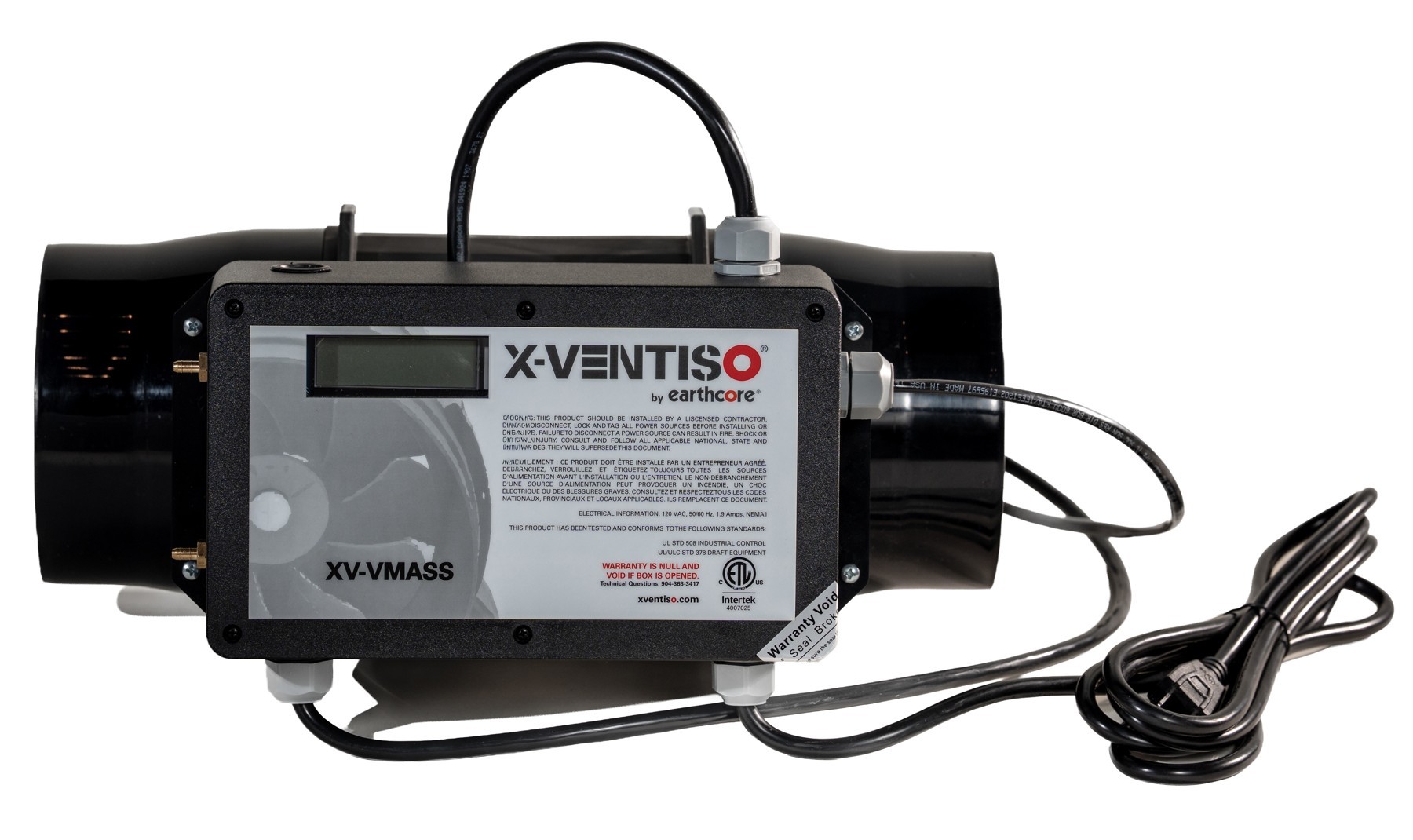
- Senses
- Its own zone, continuously
- Responds
- 25 to 400 CFM, modulating
- Tempers
- MERV 8 filter · 2.0 kW heater, second optional
- Installs
- Interlocked or always on
- Reports
- BACnet and Modbus
How it works
Senses. Responds. Tempers.
- 01
Senses
Two pressure sensors, one in the zone and one outside the envelope, report continuously. XV-FLUX controls the zone to neutral against outdoor pressure, within 0.02 in. w.c., as weather and elevation change.
- 02
Responds
Runs at a quiet 25 CFM baseline and ramps up to 400 CFM as the zone needs it, then settles back.
- 03
Tempers
Every unit filters (MERV 8) and heats incoming air (2.0 kW). In cold climates, add a second heater to double the temperature rise.
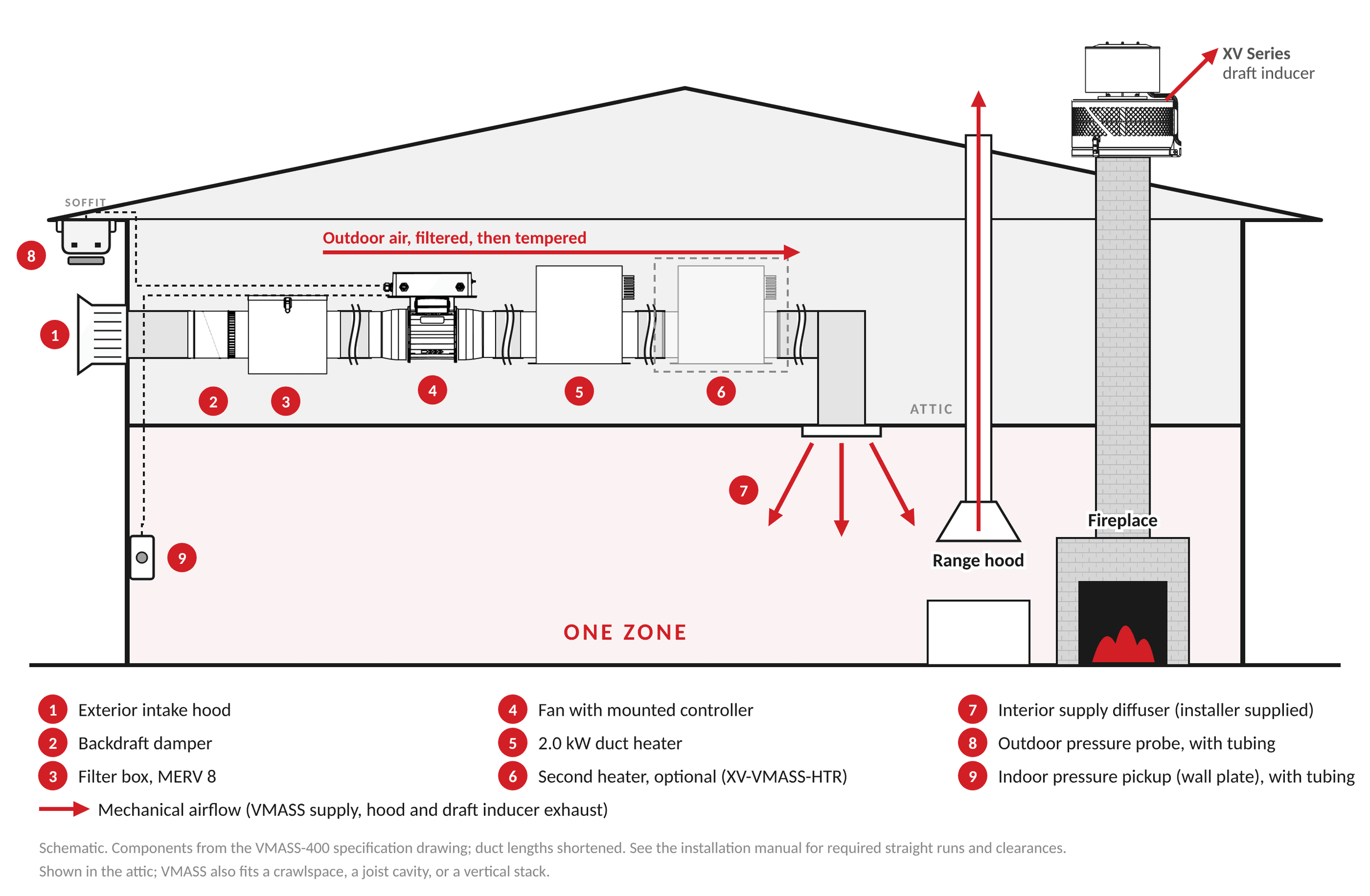
Pair VMASS with an ERV or HRV. The ERV handles ventilation air. VMASS handles makeup air, responding when exhaust and combustion appliances pull on the building.
Senses
Two Sensors. One Reading.
VMASS does not guess what the house is doing. It compares two pressures, one in the zone and one outside the envelope, and controls the zone to neutral against the outdoors.
- 8
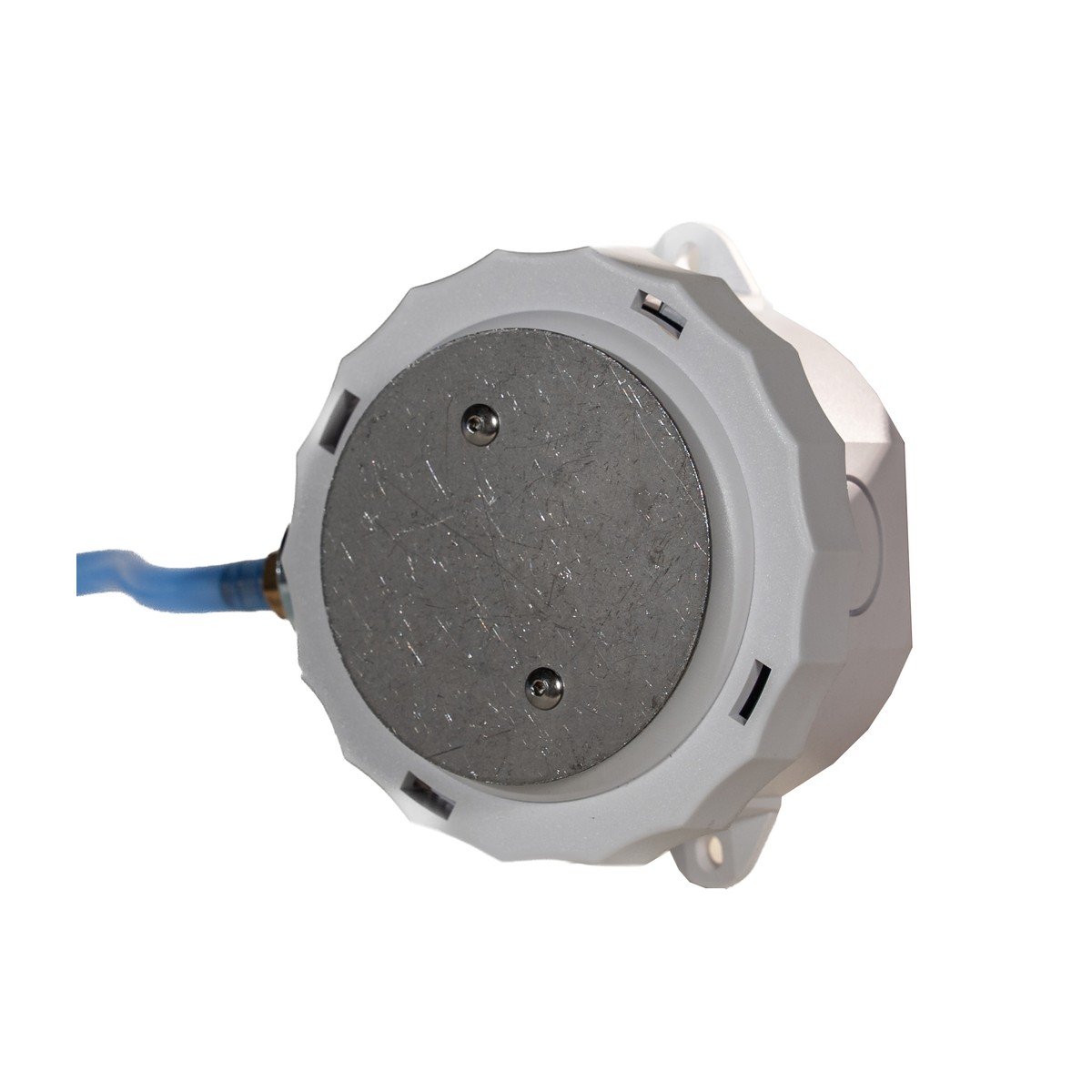
Outside the envelope
Outdoor Pressure Probe
Outdoor air reaches the sensor through a 1/16 to 1/8 in. gap behind the metal face plate. The sensor sits up inside the housing, shielded from wind. Mounts on a soffit (preferred, out of driving rain) or an exterior wall.
- 9
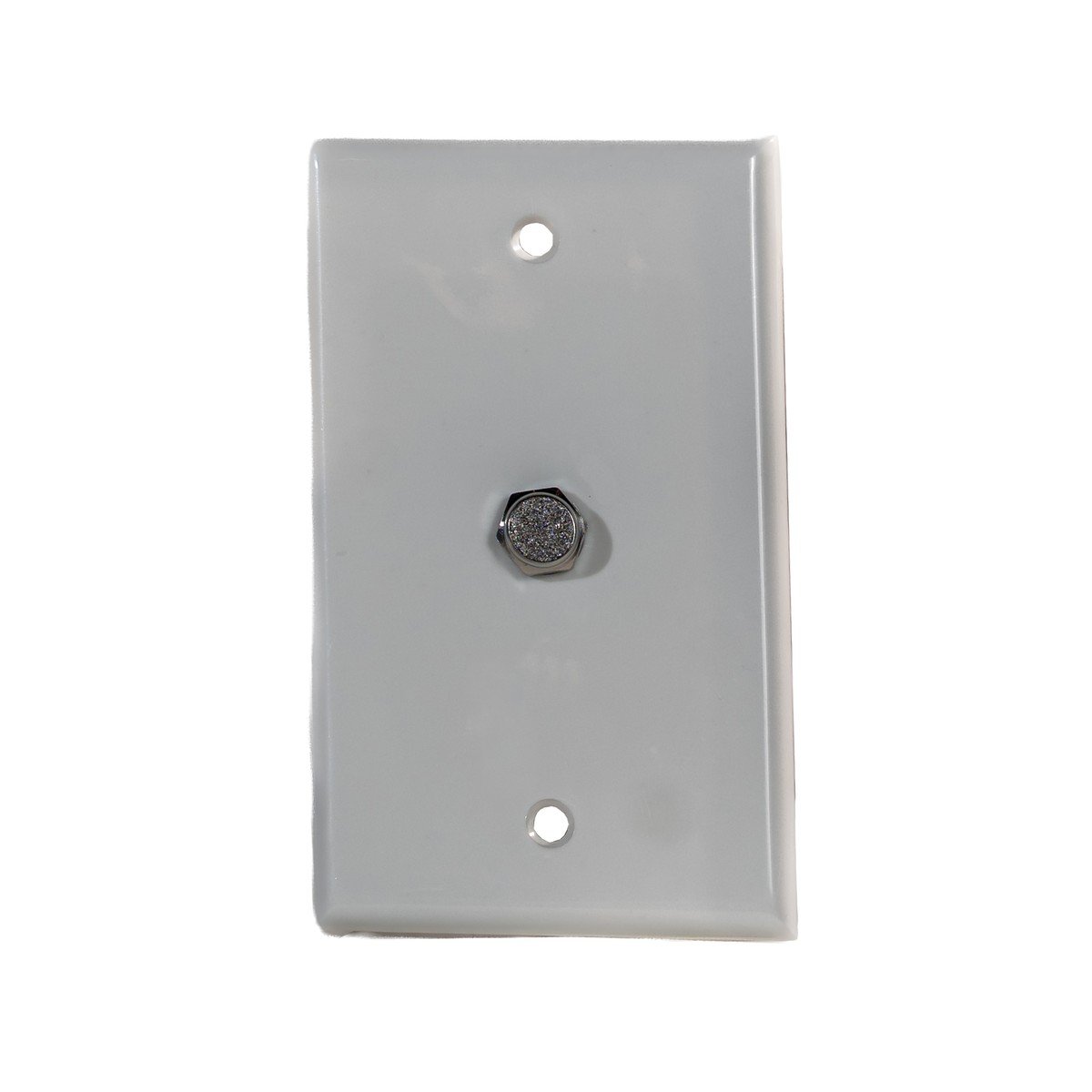
In the zone
Indoor Pressure Pickup
A standard wall plate with a built-in metal sensor port. It sits on the wall like any other cover plate.
For designers
Want a Different Finish? Use Your Own.
Each sensor is the end of a 1/4 in. tube. One needs access to the zone, the other to the outdoors. Finish either one however the design calls for: a custom plate, a grille, a detail in the millwork.
Two rules. Inside, nothing can obstruct the reading. Outside, the pickup has to be protected from wind gusts and moisture, which is the job the standard housing does. Send us the detail and we will review it with you.
Both sensors ship in the box, with tubing to the controller. Numbers match the airflow diagram above.
Room, not hood
Follows the Room, Not the Hood.
Most powered makeup air reads the hood's speed, high, medium, or low, and steps a fan to match a setting made on commissioning day. It knows what the hood is doing and nothing else.
VMASS reads the room. Hood, fireplace, dryer, bath fans, or all of them at once on a windy January night, it sees the pressure they create together and supplies only what holds the zone neutral.
Less air in means less air to heat. That is why VMASS tempers on 120 V plugs and runs on 6 inch duct, instead of a 240 V heater circuit and hood-sized duct through the framing.
Price the whole install, not the box: the circuit, the duct, the commissioning, and the heat.
Five questions to ask about any makeup air system| Compare | Tracks the hood | VMASS |
|---|---|---|
| Measures | The hood's speed | Zone pressure against outdoors |
| Sees other exhaust | No | Yes, anything that pulls the zone |
| Knows the house | Once, at commissioning | Continuously |
| Supplies | A preset share of hood CFM | Only what holds neutral, 25 to 400 CFM |
| Heater power | Sized for full hood airflow, often a 240 V circuit | 120 V plug-in, 2.0 kW per heater |
| Duct | Sized for full hood airflow | 6 inch round |
| Commissioning | Calibrate to hood speeds, balance the house | Factory-sealed, nothing to calibrate |
Fireplace makeup air
A Cracked Window Fixes a Backdrafting Fireplace.
Anyone who has cracked a window to get a smoky fireplace drafting has seen makeup air work. An inch of open window moves well under 200 CFM at typical house pressures, not the several hundred CFM a fireplace calculation shows.
The house already supplies most of the air through its own envelope. Makeup air only has to close the gap. The model code agrees: IRC R1006 expects a wood-burning fireplace's outside air to supply all of its combustion air through an opening no larger than 55 square inches. At the −7 Pa safety limit for wood-burning appliances, that opening moves only ~150 CFM.
A cracked window is makeup air with no filter, no heat, and nobody to close it. VMASS is the cracked window, done right.
Size makeup air to the pressure in the room, not to the fireplace's nameplate CFM.
Why it works: Makeup Air| Compare | Cracked window | Outside air kit | VMASS |
|---|---|---|---|
| Serves | The room | The firebox | The whole zone: fireplace, hood, dryer |
| Filtered | No | No | MERV 8 |
| Tempered | No | Not needed: it feeds the fire | 2.0 kW heater, second optional |
| Responds to the room | No, open or shut | Passive: air flows only once the room is already negative | Senses zone pressure continuously |
| Works in January | Nobody leaves it open | Yes | Yes |
| Intake on the exterior | The window itself | Low on the wall, no higher than the firebox | Wherever it is least visible, clear of chimneys, vents, and driveways |
Send us the plans.
We size the draft inducer and the makeup air, and stand behind both.
Zones
Zones, Not Appliances.
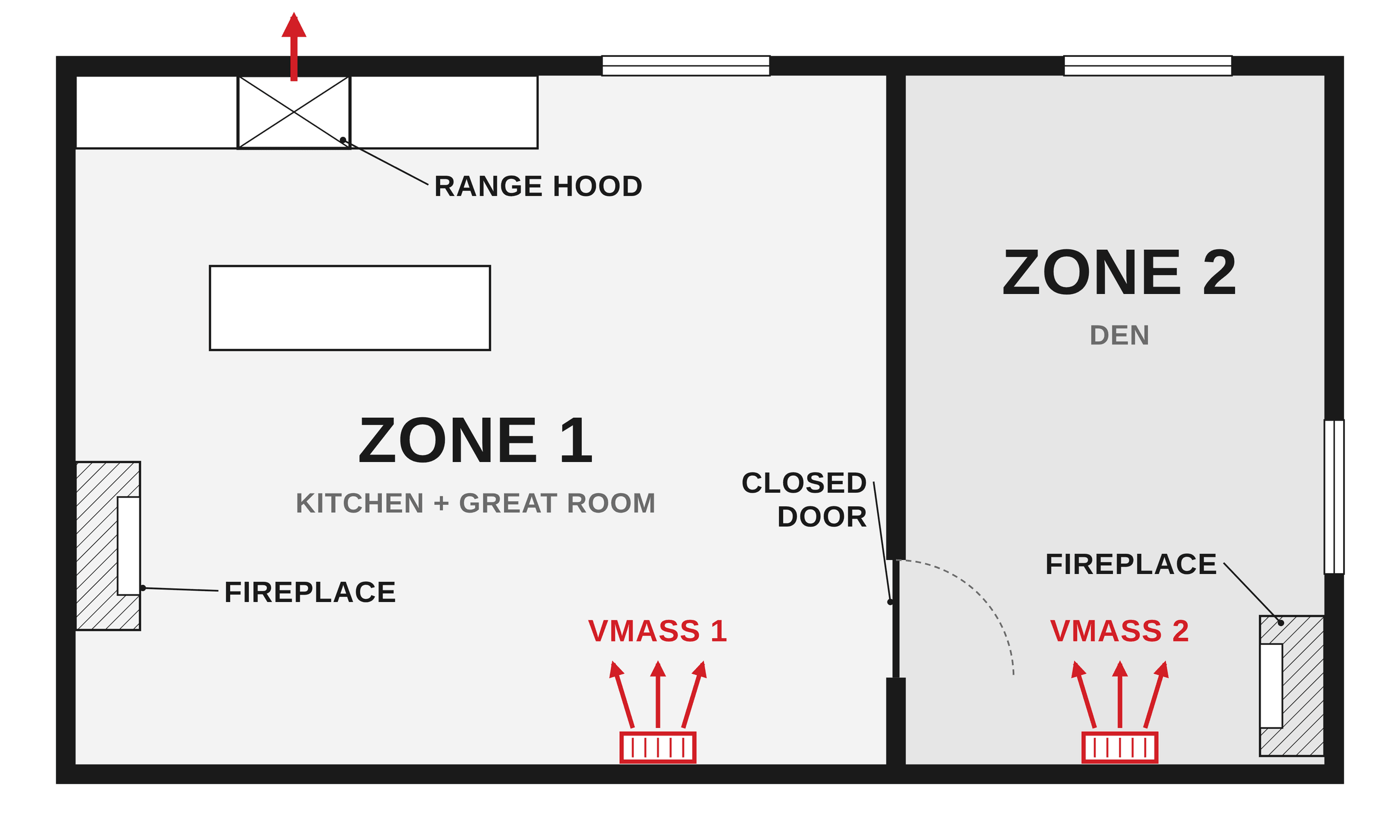
Design the zone, not the appliance list. The hood, the fireplace, and the dryer all pull on the same air. Sized one appliance at a time, each piece guesses about the others. We size the draft and the makeup air for the zone together, from your plans, as one system.
VMASS responds to the zone it serves, not to one appliance. A zone with a hood and a fireplace can share one unit. A zone whose combined demand exceeds 400 CFM gets two, and they work together without talking to each other.
Three components on one 6" duct run fit a crawlspace, a joist cavity, or a vertical stack, with 36 in. of straight duct on each side of the heater. The heater is rated for zero clearance to combustibles.
Two plugs, no hard wiring. The heater has its own 20 A plug. The fan and controller have a separate standard plug. Both plug into one dedicated 20 A, 120 V circuit at the unit. A second heater, if added, gets its own dedicated 20 A circuit.
One zone, one design, one call: the chimney and the air that feeds it.
From a real project
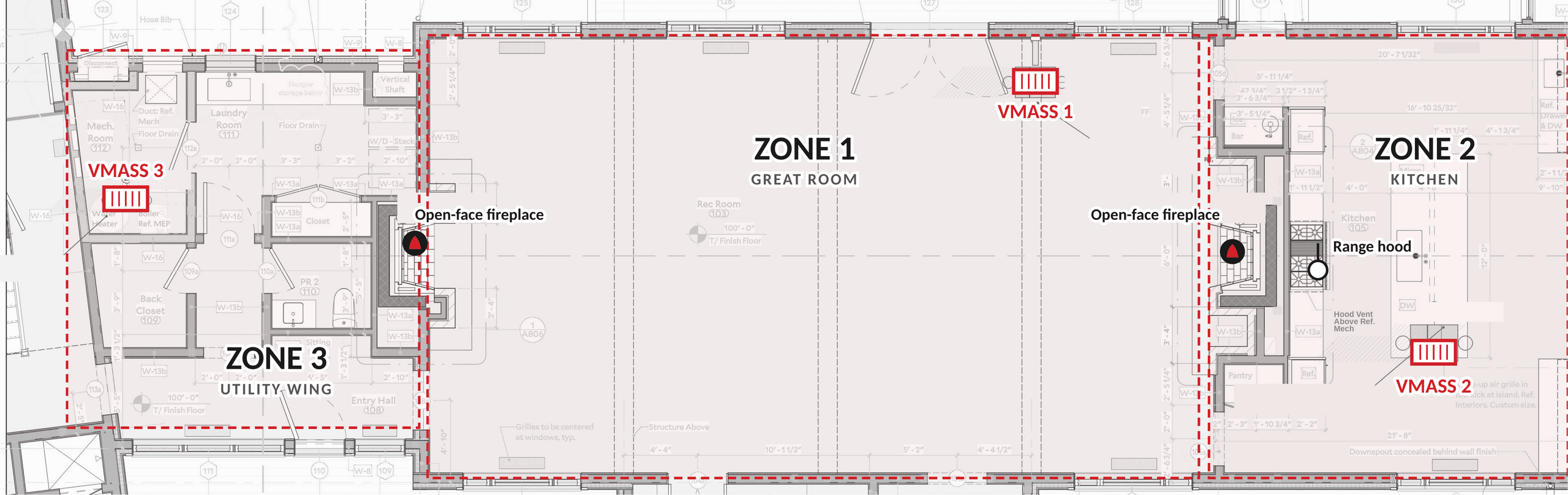
Three Zones, Three Units, Three Different Spots.
One unit at an exterior wall for a short outside-air run. One under the kitchen island, supplying through a toe-kick grille. One wall-mounted in the mechanical room. Each answers only its own zone.
Doors that can close make separate zones. The kitchen and great room share an open wall today, but doors between them can close. Nobody can predict when they will, so each side gets its own unit.
Cold climates
Twice the Heat When the Weather Turns.
Every VMASS ships with one 2.0 kW heater. For cold climates, add a second heater, sold separately. It mounts downstream of the first and connects to the VMASS controller by Molex. Every VMASS has both heater connections standard.
Two heaters double the temperature rise at every airflow. At low airflow, one heater has plenty of capacity and cycles on its thermostat. The second heater earns its place when VMASS ramps up on the coldest days.
Each heater is 2.0 kW, 16.7 A, on its own plug. The first heater shares the unit's dedicated 20 A circuit with the fan; a second heater gets its own dedicated 20 A circuit.
Run insulated duct with a vapor retarder on both sides of the unit. The intake carries outdoor air, and an uninsulated intake duct sweats in cold weather. Follow local code.
Not sure which zones need it? Send us the plans and we will size it for your climate| Airflow | One heater | Two heaters |
|---|---|---|
| 400 CFM | +16°F | +32°F |
| 300 CFM | +21°F | +42°F |
| 200 CFM | +32°F | +63°F |
| 100 CFM | +63°F | +126°F |
Temperature rise above outdoor air, calculated from heater output and airflow. Each heater holds its own set supply temperature, 61 to 90°F (75°F factory), read by its own probe in the duct. Second heater: XV-VMASS-HTR. Every VMASS has two Molex heater connections standard.
Install modes
Interlocked or Always On.
| Mode | How it is wired | How VMASS behaves |
|---|---|---|
| Interlocked | Contact closure from the appliance, directly or through the XV-INTG module | Fully off until the appliance calls, then modulates to zone pressure |
| Always on | Contact closed permanently, or on a wall switch | Idles at its 25 CFM baseline and answers anything that pulls the zone negative |
Interlocked when code requires it. Pressure-responsive all the time.
XV-INTG passes one call down the line: the draft controller starts first and VMASS last, each after the one before has answered, so makeup air is running before the appliance lights. Interlocked VMASS answers only the appliance it is wired to; always-on gives whole-zone protection where code allows.
Code
Where Code Calls for Makeup Air.
Codes call for makeup air in specific situations. VMASS answers each one the same way: it starts with the call and supplies what the zone needs.
| Situation | Code | What it asks | How VMASS fits |
|---|---|---|---|
| Kitchen hood over 400 CFM | IRC M1503.6 (M1503.4 in earlier editions) · IMC 505 | Makeup air approximately equal to the exhaust rate, starting automatically with the hood | Interlocked with the hood, VMASS starts when the hood starts and ramps to replace what it removes. One unit per 400 CFM of hood rating. |
| Atmospheric or solid-fuel appliances in the home | ASHRAE 62.2, Section 6.4 | Net exhaust of the two largest fans no more than 15 CFM per 100 sq ft, or compensating outdoor air | Powered compensating outdoor air that responds to the zone |
| Combustion safety testing | DOE Standard Work Specifications · BPI | Maximum depressurization by appliance type, set in Pascals (wood-burning: −7 Pa) | Controls the zone to neutral, within 0.02 in. w.c. (5 Pa) |
| Wood-burning fireplace | IRC R1006.1 | Exterior air supply, unless the room is mechanically ventilated and controlled so the indoor pressure is neutral or positive | Controls the zone to neutral against outdoor pressure, within 0.02 in. w.c. |
| Mechanical draft on a fireplace or appliance | NFPA 211 (2019), 4.1.2.2 to 4.1.2.4 | Must not cause other combustion equipment to spill; verified by testing with the other exhaust equipment running | Keeps the zone near neutral while exhaust runs, so the chimney is not the easiest way back in |
| Canada | NBC 9.32, as adopted provincially | Makeup air for exhaust appliances | Same approach, interlocked or always on |
Local amendments vary. Confirm requirements with the authority having jurisdiction.
BAS integration
Read Everything. Write One Thing.
VMASS connects to the building automation system over BACnet or Modbus, chosen with the order and set up at our factory before it ships. For BACnet, the BAS connects over BACnet/IP with an Ethernet cable. The building automation system can read its status and turn it on or off. Every operating decision stays inside the unit.
XV-BACnet INTF, factory-integrated.
No setpoints to write, nothing to program.
| Point | Access | Description |
|---|---|---|
| Zone pressure | Read | Live differential |
| Fan speed | Read | Supply fan |
| Power | Read | Voltage |
| System enable | Write | On / off |
In the box
What Ships With Every VMASS.
Filtration
Filter Cabinet
Inline cabinet with a MERV 8 filter. First in the airflow.
Air
Fan and Controller
Supply fan with the controller mounted on it. Standard 15 A plug.
Tempering
2.0 kW Duct Heater
Inline electric heater, zero clearance to combustibles. Its own 20 A plug. Mounts downstream of the fan.
Reference
Outdoor Pressure Probe
Round exterior housing with a metal face plate that shields the sensor from wind, with tubing. Mounts on a soffit (preferred) or an exterior wall and gives VMASS the outdoor pressure it controls the zone against.
Reference
Indoor Pressure Pickup
Standard wall plate with a built-in metal sensor port, with tubing. Mounts in the zone VMASS serves.
Intake
Exterior Intake Hood
Weather hood for the outdoor air intake.
Backflow
Backdraft Damper
Integrated 6" passive backdraft damper.
Docs
Installation Manual
Included in the box. Also available under Downloads.
Installer supplies: 6" insulated duct with a vapor retarder (recommended on both runs; follow local code), the interior supply diffuser, and a dedicated 20 A, 120 V circuit at the unit. Optional: second heater, XV-VMASS-HTR, on its own dedicated 20 A circuit.
Specifications
VMASS Specifications.
| Specification | Value |
|---|---|
| Airflow | 25 to 400 CFM, modulating; 25 CFM baseline |
| Supply connection | Into the zone through its own outlet (diffuser, toe-kick grille, or linear slot), or through a divided register boot that shares the HVAC grille. See the installation manual for climate-zone rules. Outlet by installer |
| Pressure control | Controls to neutral against outdoor pressure, within ±0.02 in. w.c. (±5 Pa) |
| Pressure sensing | Two references, both included: indoor pressure pickup (standard wall plate) and outdoor pressure probe in its housing, each with tubing to the controller |
| Duct connection | 6" round, supply and intake |
| Filtration | Inline MERV 8 filter cabinet |
| Tempering | 2.0 kW inline electric duct heater, zero clearance to combustibles. Second 2.0 kW heater available as an accessory (4.0 kW total) |
| Backflow | Integrated 6" passive backdraft damper |
| Components | In airflow order: filter cabinet, fan with mounted controller, heater. The heater always sits downstream of the fan. Connected by 6" duct |
| Heater connections | Two Molex heater connections on the controller, standard on every VMASS. One heater included; second heater XV-VMASS-HTR optional |
| Electrical | 120 VAC, 60 Hz, single phase. Each heater 2.0 kW, 16.7 A. Fan and controller 1.9 A |
| Power connections | Two cords. Heater: 20 A plug (NEMA 5-20P), 6 ft cord. Fan and controller: standard 15 A plug (NEMA 5-15P), 8 ft cord. Both to one dedicated 20 A, 120 V circuit (NEMA 5-20R receptacle). Second heater (accessory): its own 20 A plug, on its own dedicated 20 A, 120 V circuit |
| Controls | BACnet/IP (XV-BACnet INTF, factory-integrated, Ethernet) or Modbus RTU, set up at the factory; on/off by contact closure |
| Listings | Built from individually listed components. Fan: UL Listed, with AMCA Certified Ratings for air and sound performance · Duct heater: UL 1996, CSA C22.2 No. 155 (ETL Listed) · Controller: UL 508 Industrial Control, UL/ULC 378 Draft Equipment (ETL Listed, Intertek 4007025) |
| Airflow note | Rated airflow requires low duct static pressure; size runs accordingly |
Downloads